
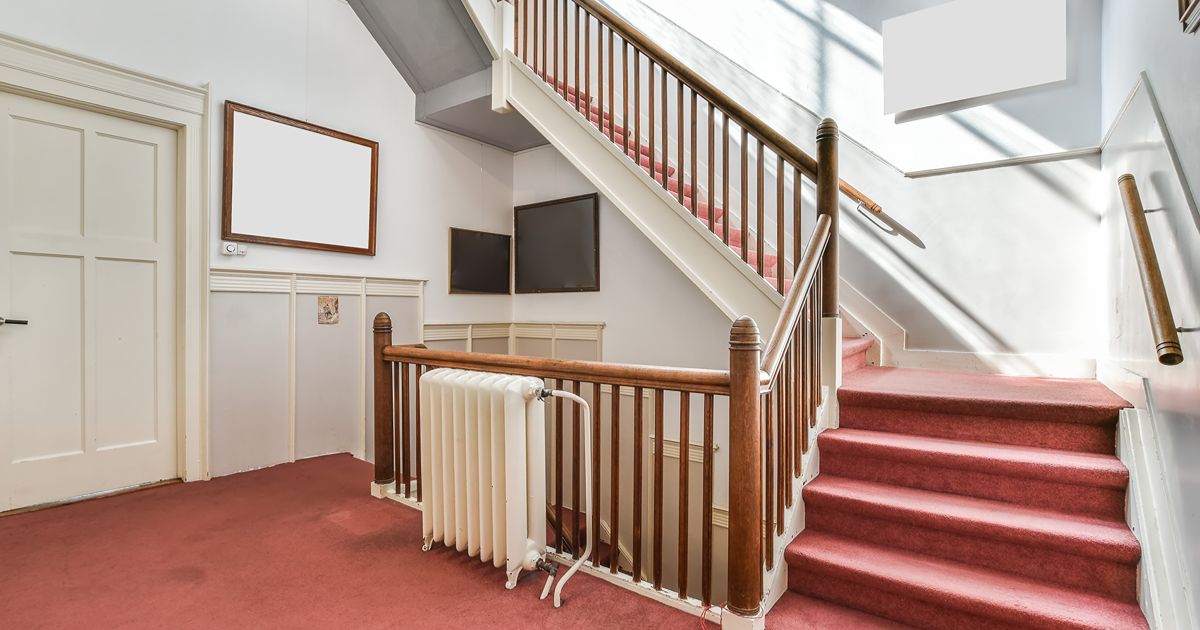
The upstairs is warmer than the downstairs because heat rises, the attic above it is brutally hot, and most Kendall two-story homes send less cooling to that upper floor than it needs.
Add a single thermostat sitting downstairs, and the system shuts off long before the bedrooms catch up.
A three- to five-degree spread is common in a two-story house. Anything past that points to a real problem with return air, ductwork, or insulation, and a bigger air conditioner will not solve it.
Why the Upper Floor Loses This Fight Every Afternoon
Three things stack up against the second floor. Warm air rises and collects at the top of the house.
The attic above the ceiling runs far hotter than the outdoor air on a Kendall afternoon. And the ducts feeding those upstairs rooms usually run through that same attic, so cool air warms before it reaches a vent.
The Department of Energy’s home heating and cooling guide explains how attic heat drives cooling loads. Upstairs rooms need more cooling than downstairs, and most systems deliver less.
Is the Problem Return Air Instead of Supply Air?
Most of the time, yes. Homeowners watch the vents blowing cold air in, but a room only cools as fast as air leaves it.
If the second floor has one small return, or none at all, air backs up and the supply vents cannot push much in.
Signs you have a return air problem:
- Doors upstairs pull shut or resist opening when the system runs.
- Bedrooms get much warmer with the doors closed than with them open.
- Airflow at upstairs vents feels weak even though the air is cold.
- The downstairs is freezing while the upstairs sits several degrees warmer.
Adding an upstairs return, enlarging an undersized one, or cutting door undercuts often does more than any equipment change.
Check the simplest item first. A dirty filter chokes the system and starves the farthest rooms, which is why you change your filter on a schedule.
What Ductwork Problems Look Like on the Second Floor
Duct problems show up as rooms worse than their neighbors, not an evenly warm house. A long, crushed, or disconnected branch line leaves one bedroom hot while the room next door is fine.
Common culprits in Kendall homes:
- Flex duct kinked over a truss or sagging between supports.
- Branch runs too small for the distance they travel.
- Torn or compressed insulation on ducts sitting in attic heat.
- Dampers closed or never balanced after an earlier repair.
- A disconnected run dumping cold air into the attic instead of the room.
That last one is more common than people expect, and it explains both a hot bedroom and a power bill that jumped for no reason.
If yours climbed, the causes behind high electric bills frequently trace back to the same attic.
Why Your AC Runs All Day and Still Cannot Catch Up
Because the downstairs thermostat is satisfied. It reads 74 in the living room, shuts the system off, and the upstairs sits at 79 with nobody asking it to cool.
The run time cools the second floor, and a thermostat in the wrong place ends the run early.
A system that never seems to finish signals something different. When a house is slow to cool on both floors, the issue is usually capacity, charge, or a dirty coil rather than balance between levels.
Sorting out which pattern you have saves money, because the fixes barely overlap.
Humidity muddies this too. A second floor only two degrees warmer can still feel much worse if moisture is high, and the moisture side of humid weather issues deserves its own look.
What Actually Fixes a Hot Upstairs
Work in order of cost, because the cheap fixes solve this more often than the expensive ones.
- Replace the filter and open every supply vent, including in unused rooms.
- Have the return path evaluated and enlarged if it is undersized.
- Seal and repair attic ducts, then balance the dampers between floors.
- Add attic insulation if it sits below current standards.
- Consider zoning with motorized dampers and a second thermostat.
- Add a ductless unit for one problem room if you can’t improve the ductwork.
Most Kendall homes get resolved in the first three steps. Zoning and ductless equipment are real answers, but only to a duct problem you have already confirmed.
When to Stop Guessing and Get It Measured
Call for Kendall AC repair when the spread is over five degrees, when one room is far worse than the rest of its floor, or when the upstairs never reaches setpoint on a hot day.
A technician should measure supply and return temperatures at the air handler, check static pressure, and read airflow at vents on both floors.
Numbers, not opinions. Knowing how repairs work helps you tell a real diagnostic from a guess.
One limit worth naming: a two-story home will never be perfectly even, and no repair makes it so.
The goal is getting the spread down to a range you stop noticing, not zero.
Before You Spend Money on a Bigger Unit
Replacing a working system with a larger one is the most expensive way to mess this up.
Oversized equipment runs shorter cycles, which starves the upstairs further and leaves the house damp.
Get the return air, duct condition, and airflow measured first. If the numbers say the equipment is undersized, you will have the proof in hand.